




New Pre-Approval Process for Bermuda Funds
The Bermuda Monetary Authority (the “BMA”) has introduced an approval in principle (“AIP”) process designed to support the more efficient establishment of new investment funds that are proposed to be registered or authorised under the Investment Funds Act 2006 (the “Act”). In its notice to the public, the BMA indicated that AIP applications are expected to be processed on an expedited timeframe, generally within 2 to 3 business days following submission of the required documentation, compared with the timing for a standard registration or authorisation application.
However, the BMA’s notice made clear that AIP should be viewed as a preliminary step in the launch timetable, rather than as a substitute for registration or authorisation under the Act. Accordingly, after receiving AIP, a fund must then submit a formal registration/authorisation application to the BMA for approval before commencing business, accepting subscriptions or representing itself to investors as having been registered or authorised under the Act.
In practice, the AIP process may assist sponsors and managers in planning Bermuda fund launches by providing an earlier regulatory checkpoint. Launch timelines should nevertheless continue to build in time for the full application process. In addition, offering or investor marketing materials should not describe the fund as registered or authorised until final BMA approval has been obtained.
Cayman Islands Fund Deregistration Process
The deregistration of a Cayman Islands fund with the Cayman Islands Monetary Authority (“CIMA”) and the subsequent winding-up and dissolution of the legal vehicle are related but distinct processes, each subject to its own requirements. Together, they require close coordination between sponsors, auditors and Cayman Islands counsel.
Key steps for deregistration include:
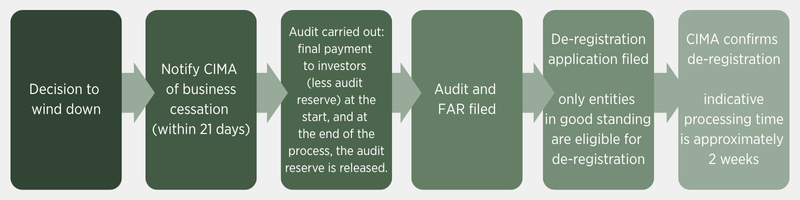
- notifying CIMA of ceasing or intending to cease business within 21 days;
- completing and filing final audited financial statements and fund annual returns with CIMA ensuring the fund is in good standing, including payment of all outstanding CIMA fees and any penalties, and that all prescribed filings are up to date; and
- filing the formal application for deregistration with CIMA.
Once CIMA has confirmed the deregistration, the entity can then be wound up and dissolved in accordance with the applicable Cayman Islands legislation:
- For an exempted limited partnership, the voluntary winding up of the partnership will, subject to the terms of the relevant partnership agreement, either be: (a) at the time or upon the occurrence of an event specified in the partnership agreement; or (b) where there are no dissolution provisions in the partnership agreement, by a resolution of all the general partner and a two-thirds majority of the limited partners. Following the commencement of a voluntary winding up, the general partner (or liquidator) will file notice of the winding up with the Registrar of Exempted Limited Partnerships and publish notice of the winding up in the Cayman Islands Official Gazette. For partnerships registered on or after 11 May 2009, such Registrar filing and Gazette publication must be completed within 28 days of the commencement of the voluntary winding up. Having identified and liquidated all assets, discharged all liabilities of the partnership and made distributions to the limited partners, a notice of dissolution signed by the general partner (or liquidator) will be filed with the Registrar. The timetable for the winding up and dissolution of a partnership will therefore depend upon asset complexity and creditor claims.
- For an exempted company, a voluntary liquidation will normally involve shareholder approvals, the appointment of a voluntary liquidator, publication of notices, a final general meeting and filing of the final return with the Registrar of Companies. This process typically takes approximately one to two months (indicative only). An exempted company is deemed dissolved 3 months after the filing of the final return with the Registrar.
We strongly encourage clients to engage early – ideally well before the anticipated termination date or year-end deadline – to ensure all filings and approvals are completed in time. For funds aiming to complete deregistration, winding up and dissolution before 31 December, please note that CIMA processing times can be affected by increased volume during Q4. A failure to complete the process before year-end may result in continued regulatory and filing obligations into the following calendar year. Please contact your usual Conyers representative for guidance and support.
The diagram below outlines the typical steps for the CIMA deregistration process; i.e. it does not address the separate winding up and dissolution of the entity. The timing referenced in the last box of the diagram is indicative only and not guaranteed, particularly during Q4.